
Why Growth Can Feel Like Grief
Sometimes the hardest losses are the versions of ourselves we can no longer be.

I first read Judith Viorst’s Necessary Losses in college.
At the time, I was trying to understand something I experienced at a much younger age than my college self. I was trying to make sense of the fifteen-year-old whose father left one day and never really came back.
Like many children, I thought healing meant figuring out how to stop missing him. I wanted an explanation. A framework. Something that would make the loss feel purposeful instead of random.
I didn’t realize what I was really searching for was permission to grieve a relationship that had never ended in the way people usually imagine endings. My father was still alive. I simply no longer had access to him.
Necessary Losses was one of the first books that gave me language for that experience.
Viorst writes that loss isn’t simply an interruption of life. It’s woven into the process of becoming fully human. We don’t just lose people. We lose childhood illusions. Certainty. Ways of belonging. Dreams we assumed would come true. Versions of ourselves that once made perfect sense.
I remember feeling comforted by that idea, though I don’t think I fully understood it.
At twenty-one, I read the book as a daughter. Nearly twenty years later, I’m reading it as an adult.
And now I think its deepest lesson isn’t that loss is inevitable. It’s that growth almost always asks something of us before it gives us anything back.
I see myself then, newly in my twenties, reading a paperback of Necessary Losses from my university’s library on my bed in my small attic room, longing for understanding and hope that someday I might have my dad back.
I wish I could tell her what I couldn’t have known then, but I know now: life is going to get so much harder. The grief will pile up. But learning how to hold that grief and refusing to settle for a numb life, will lead to more beauty, relationships, and self-connection than you ever thought was possible.
Sometimes We’re Grieving the Person We Can No Longer Be
I’ve been thinking about that book again lately. Not because another chapter of my life has neatly come to an end. But because I’m living inside one that hasn’t.
One of the strangest parts of the season I’m in is fully feeling how many things can be true at the same time.
I can deeply love someone.
And I can also recognize that the versions of ourselves who first built our relationship aren’t capable of building the future we both say we want.
That isn’t criticism. It’s grief.
If my partner wants the life he talks about — health, meaningful work, deep partnership, a family — he has to outgrow the identities that taught him to hide, numb, and carry shame alone.
If I want those same things, I have to outgrow the identities that taught me love meant overfunctioning. Anticipating. Rescuing. Believing that if I could just understand enough, communicate clearly enough, or love deeply enough, I could somehow carry another person toward healing.
Those identities didn’t appear out of nowhere.
They protected us. They helped us survive earlier chapters of our lives.
But survival strategies aren’t always the same things that allow us to build the futures we long for.
That’s the part I’m grieving. Not simply the uncertainty of what happens next.
I’m grieving the realization that neither of us gets to bring our old identities into the life we say we want.
Whether we eventually build that life together, or eventually apart, I genuinely don’t know. This is the risk involved in choosing a fully present life.
And maybe that’s what makes this grief so difficult.
I’m not only mourning a relationship. I’m mourning the certainty of a future I had already begun living inside.
The version of myself who thought I knew what this year would look like. The version who believed motherhood was just around the corner. The version who thought I had finally arrived in the life I’d spent years building with someone.
Sometimes grief isn’t about losing what was. Sometimes it’s about losing what we believed would be. Who we believed we would be.
But then I remember a moment with my partner this week. Looking at each other and smiling, feeling how seeing each other more clearly is the greatest gift anyone could ever give each other.
How giving someone an opportunity to be let into where you currently are, not just where either of you hoped you’d be, is beautiful. Even if disappointing. Even if uncomfortable. Even if scary.
It’s a place that’s alive.
We can choose to take pleasure wherever we are. To find the beauty and gratitude even amidst the loss. This is one of the gifts of necessary losses.
The Grief No One Teaches Us to Name
We tend to think grief belongs to obvious endings.
Someone dies. A marriage ends. A diagnosis arrives. A job disappears.
Those losses have rituals. People bring casseroles. They send sympathy cards. They take you to happy hour. We know what to call them.
But what about the losses that don’t come with a funeral, a divorce, a treatment plan, or a future job recommendation?
Psychologist Pauline Boss has spent decades studying what she calls ambiguous loss — losses that remain psychologically present because they never receive a clear ending.
A parent who is still alive but no longer part of your life.
Someone living with addiction.
An estrangement.
An uncertain relationship.
The future you imagined but never got to live.
These experiences are uniquely painful because they resist resolution. There’s no moment where the story cleanly ends. No cultural script for how to move forward. We simply carry them.
The more I’ve learned about ambiguous loss, the more compassionate I’ve become toward myself.
I wonder how many of us are walking around carrying grief we don’t even realize we’re allowed to have.
Grief for identities we’ve outgrown. Old dreams. Communities that no longer fit.
Grief for the versions of ourselves that once helped us survive but can no longer accompany us into the next chapter.
Our Brains Experience Growth as Loss
One of the most surprising things I’ve learned while studying neuroscience is something I wrote about last week: the brain isn’t primarily trying to make us happy.
It’s trying to make the world predictable.
Every day, our brains generate models of who we are, how relationships work, what belonging looks like, and what we should expect next. Those predictions become incredibly efficient. They help us move through life without having to reinvent ourselves every morning.
But they also become deeply attached to familiarity.
Not because familiarity is always healthy.
Because it’s known.
If you’ve spent years believing your value comes from rescuing other people, your brain becomes very good at predicting a world where rescuing leads to connection.
If you’ve learned that drinking is how you belong, Friday night begins to carry an entire story.
If you’ve built your identity around independence, letting someone help you can feel strangely threatening, even if it’s exactly what you need.
Growth asks those predictions to change. Which means it doesn’t simply ask us to learn something new. It asks us to practice becoming someone our nervous system has never met before.
No wonder it feels disorienting. No wonder we sometimes mistake growth for failure.
Every New Chapter Requires a Necessary Loss
Carl Jung believed the central task of adulthood wasn’t becoming someone different.
It was becoming more fully ourselves. He called this process individuation.
I find that idea both comforting and heartbreaking.
Comforting because it suggests that who we are becoming has always been somewhere inside us.
Heartbreaking because every act of becoming asks something else to end.
The perfectionist.
The rescuer.
The addict.
The overachiever.
The chronic caretaker.
The person who learned exactly what was necessary to survive one chapter of life, only to discover those same strategies are preventing them from entering the next.
Jung famously wrote,
“There is no coming to consciousness without pain.”
For years, I thought that sounded unnecessarily bleak.
Now I hear something much kinder.
I don’t think he was glorifying suffering. I think he was describing the emotional cost of awareness.
We can’t realize an identity no longer fits without first feeling the discomfort of wearing it.
Perhaps grief is simply what it feels like to make room.
Creativity Gives Grief Somewhere to Go
In 2020, I found out my boyfriend had been cheating on me for our entire relationship while being paranoid I was cheating on him, and then in the midst of lockdown, my friend died after being hit by a drunk driver on her way to work.
Isolated during quarantine and drowning in grief, I made a decision.
I would surrender to the grief. I would let it transform me. I would observe and take notes on how it helped me to become someone new.
For me that meant allowing myself to feel the full impact of my grief. To be wrecked by it. To cry for as long as I needed. To show up for myself as the kind, accepting, and gentle parent I’d always needed. To choose self-compassion and my deepest desires over fear and role-based relational performances.
I would choose to make each of my next moves intuitively. To let my grief crack me open rather than shut me down. To show me it is safe to trust myself and the world even though it hurt me so much.
As soon as it was safe, I sold all my belongings and began traveling with my dog and cat in my truck. I would learn to live the questions. I would practice everything I learned as a writer and artist up to that point and apply it to my life.
I would embrace uncertainty. I would follow my interests and whims. I would trust the process.
For a long time, I thought creativity was something you did after life settled down.
I imagined I’d write more once I felt confident. I’d make better work once I had more clarity. I’d return to my creativity after the grief had passed and I finally felt like myself again.
Life has never worked that way.
Looking back, almost every meaningful creative project I’ve ever made has emerged from a season of profound uncertainty.
I wrote while I was drowning in debt, selling books I loved just to afford groceries and wondering if I’d ever experience financial stability. I kept sending my novel out, even after years of rejection, because something inside me still believed the story deserved a life beyond my hard drive.
More recently, I’ve found myself planting flowers, training for a marathon, building Creative Reset Studio, and applying to graduate school to become a therapist — not because my grief has disappeared, but because it needs somewhere new to move.
That’s the thing no one tells you.
Grief is energy.
Love is energy.
Hope is energy.
If they aren’t given somewhere to go, they have a way of turning inward.
Sometimes they become anxiety.
Sometimes depression.
Sometimes addiction.
Sometimes control.
Sometimes endless rumination about a future we can no longer change.
For me, creativity has become another possibility.
Not an escape from grief. A relationship with it.
Growing Larger Than Our Grief
For most of my life, I believed healing meant feeling less.
Less sadness. Less fear. Less anger. Less uncertainty. Less grief.
Now I know I’ve had it backwards.
What if healing isn’t about reducing the size of our grief? What if it’s about expanding the size of our lives?
The older I get, the less interested I become in the fantasy of reaching some permanent state of emotional peace. I don’t think that’s what emotionally healthy people experience.
I think they experience the full range of being alive.
They continuously develop a greater capacity to hold and let go of all of it. To let life flow through them.
The capacity to love someone while accepting they cannot change for them. The capacity to hope without demanding certainty. The capacity to grieve one future while remaining open to another. The capacity to stay present instead of abandoning ourselves whenever life becomes painful.
When I look back at my twenties, I don’t think I experienced less grief. I think I had a smaller container to hold it all.
Every disappointment felt like my entire life.
Every ending felt permanent.
Every uncertainty felt unbearable.
Slowly — and mostly through therapy, creative practice, relationships, and a great deal of failing — that container has grown.
The grief hasn’t become smaller. I’ve simply become larger.
Returning to Necessary Losses
When I first read Necessary Losses, I thought Judith Viorst was teaching me how to survive what life would inevitably take away.
Now I think she was pointing toward something much more hopeful.
Necessary losses aren’t simply what life takes from us. They’re also what create the conditions for us to become someone new.
The daughter who eventually became her own source of belonging.
The artist who stopped waiting for permission.
The partner learning that love doesn’t require self-abandonment.
The person discovering that certainty was never the goal. Presence was.
Maybe that’s why every meaningful transition feels so disorienting.
We’re not only leaving something behind. We’re meeting someone we’ve never been before.
And introductions like that are rarely comfortable.
Grief isn’t evidence that we’re moving backward, though it can sometimes feel like it. It’s merely evidence that something mattered to us — deeply.
Healing doesn’t ask us to love less. Or hope less. Or grieve less.
Some grief will stay with us for the rest of our lives. The goal isn’t to become someone who no longer feels it. It’s to become someone whose life grows spacious enough to carry grief, hope, love, and possibility all at the same time.
When I first read Necessary Losses, I thought the title described what life would inevitably take from me.
Now I think it describes something else entirely.
The identities we eventually thank. The dreams we lovingly release. The certainty we surrender. The versions of ourselves that carried us exactly as far as they could.
Because maybe the opposite of grief isn’t happiness.
Maybe it’s capacity.
The capacity to keep loving after disappointment. To keep creating after heartbreak and participating in a life that no longer looks the way we imagined.
And maybe that’s the quiet work of adulthood.
Not avoiding necessary losses or rushing to replace them. But allowing them to enlarge us.
To make us more compassionate. More curious. More alive. More fully ourselves.
Before You Go...
If you’ve been walking through a season of transition yourself, I hope this essay reminds you that grief isn’t always a sign you’ve taken a wrong turn.
Sometimes it’s evidence that you’re standing at the edge of a new chapter, even if you can’t see it yet.
That’s one of the reasons I’m building Creative Reset Studio.
Not simply as a place to make art, start a new business, or create content, but as a place to practice becoming.
Each week we’ll create together, reflect together, and build the emotional flexibility to stay present with uncertainty instead of immediately trying to escape it.
Creativity isn’t the reward we receive after healing.
It’s one of the ways we grow into people capable of holding more of life. More of ourselves. More of each other.
Hi, I’m Bowie 👋🏼
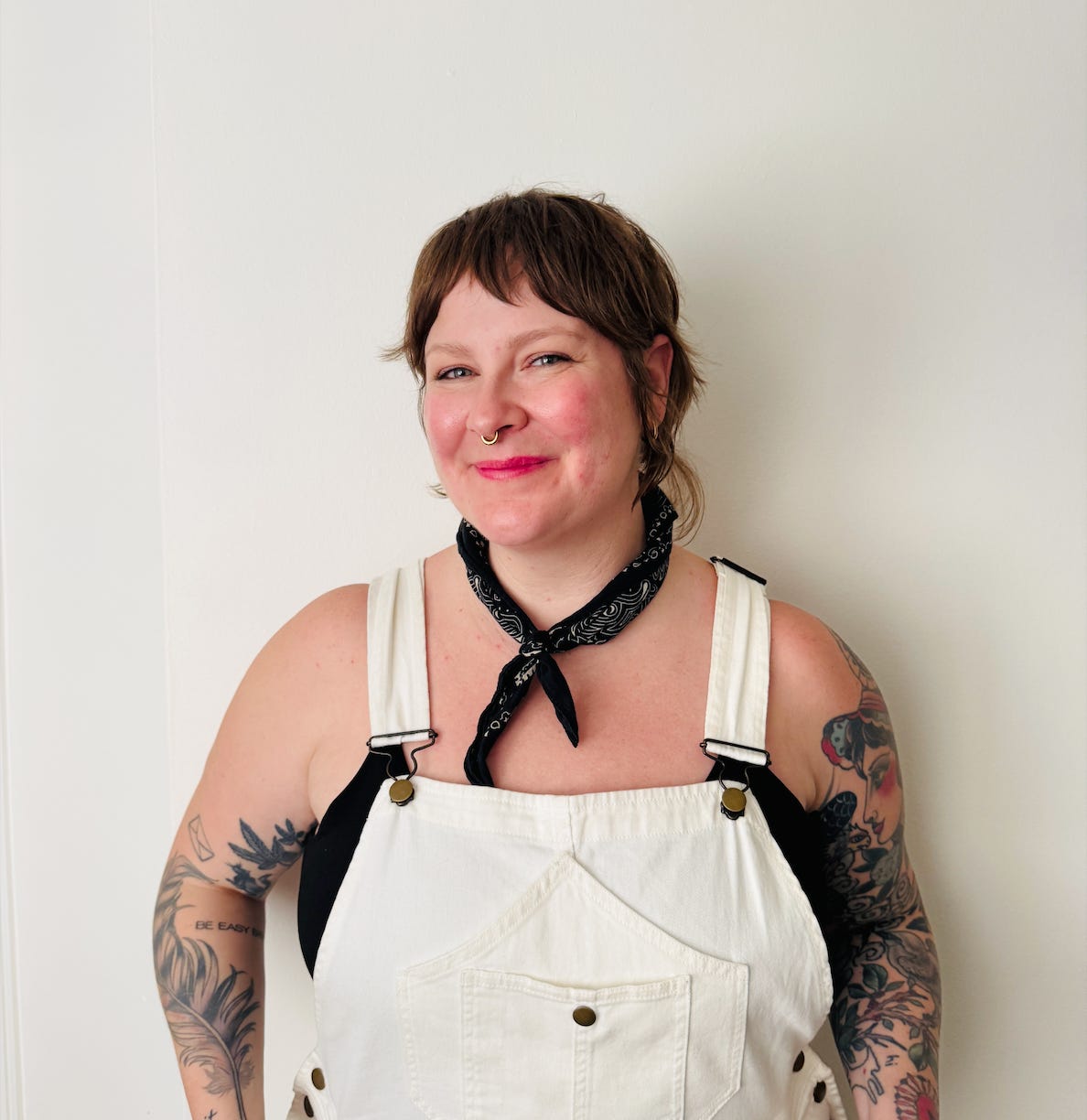
I write about creativity, relationships, psychology, and reinvention — and how we stop surviving and start participating in our lives again.
If this essay resonated, consider subscribing. New essays arrive every Monday, with practical guides every Thursday.
Reply here or send me a message on Instagram @bowierowie if you’d like to learn more about the Creative Reset Studio — Founding Membership or DO SOMETHING DIFFERENT: A Relationship Lab, both opening this summer.